
Choosing Between an Air Classifying Mill and a Hammer Mill: A Complete Guide
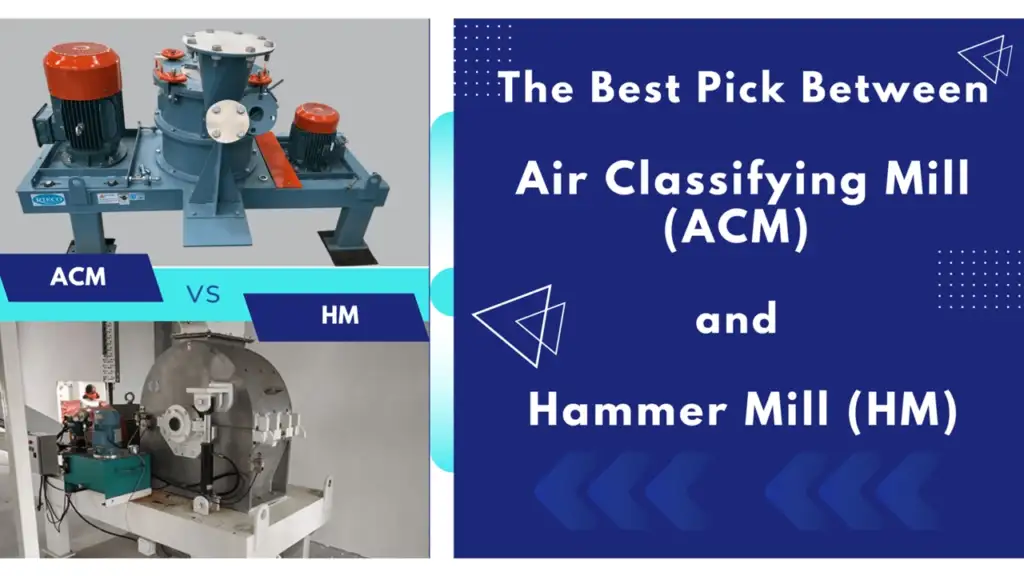
Air Classifying Mill
Introduction
Size reduction is an important unit operation in the chemical, power, mineral, metallurgical, and pharmaceutical industries. While many sources explain the fundamentals of material size reduction, few teach how to select and size the right type of mill, operate it efficiently, and maintain it. Among the many types of grinding mills, this article focuses on two widely used options: the hammer mill and the air classifying mill (ACM). Hammer mills are used for general-purpose grinding and can produce finished product particle sizes ranging from millimeters to tens of microns. The ACM is primarily used for superfine grinding and creates a uniform particle-size distribution down to a few microns. Understanding each mill’s grinding mechanism and operating philosophy helps compare the two.
A Quick Comparison Between Air Classifying Mill & Hammer Mill
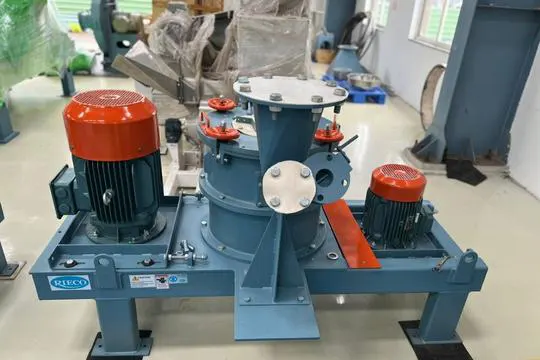
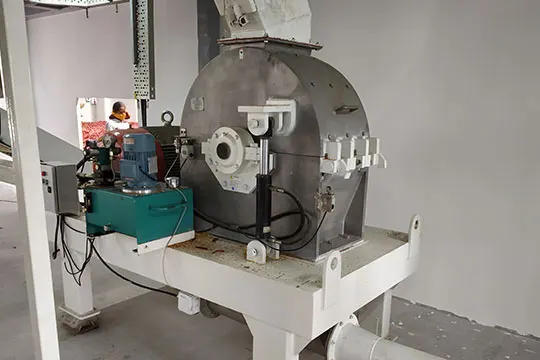
| ACM | Hammer Mill |
|---|---|
| Air Classifying Mill (ACM) integrates grinding, classifying, conveying, and collecting to achieve ultra-fine grinding (down to ~2 µm*, depending on product). | Hammer mill grinds by impact, with sieving and collection. Product can be collected at the bottom by gravity or via a pulsed-jet product collector for dust-free operation. |
| Grinding occurs as product meets a pin- or bar-type rotor disc. Reduced particles are entrained by the airstream entering below the rotor and carried up between the inner wall and shroud ring with baffles, deflected by an air-dispersion ring to the separator. Acceptable product is collected by a high-efficiency bag filter; oversize returns to the rotor for further grinding. | Consists of a series of hammers (usually four or more) hinged on a central shaft within a rigid metal case. Material is struck by hammers rotating at high speed and passes through screens to achieve size reduction. |
| Can be designed for hygroscopic, heat-sensitive, or explosive materials using inert gas/closed-loop systems with dry, chilled air. | Best for free-flowing, non-hygroscopic, non-heat-sensitive, and non-explosive materials to produce consistent particle-size distributions. |
Parameters of Comparison – ACM & Hammer Mill
Comparing any machine depends on the following parameters:
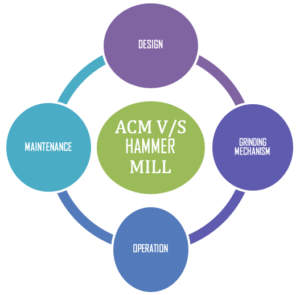
Design:
The Air Classifying Mill (ACM) has a flexible design capability and can be tailored to specific applications. It supports temperature-controlled grinding, inert milling, and cryogenic milling. The clam-shell body design provides easy access to the grinding chamber. Pressure-resistant piping and disposable liners, classifier wheels, and grinding pins/bars/hammers are available.
By contrast, hammer mills use variable hammers to produce fine product. Shaft speed is a primary design aspect and is often regulated by a frequency converter. Hammer mills can include provisions to intercept foreign bodies (e.g., metal particles).
Operation:
In an ACM, product enters the grinding section via feed screw or pneumatic conveying through a rotary airlock. Particles break on impact and are swept to the internal classifier that rotates with the rotor disc. Particles circulate until they meet the classifier cut point, then are collected (e.g., cyclone/bag filter).
Hammer mill operation is straightforward: material enters a feed hopper, moves to the crushing chamber, and is repeatedly impacted by swinging or fixed hammers until it passes through the selected screen. ACMs typically require a cyclone, bag filter, fan arrangement, and compressed air; standalone hammer mills generally do not.
Grinding Mechanism:
The ACM uses centrifugal force and controlled airflow to transport and classify particles continuously until the target size is achieved.
In a hammer mill, a rotor with hammers mounted on a horizontal or vertical shaft impacts material; the screen aperture dictates the final size. In ACMs, particle size is governed by the classifier cut point.
Maintenance:
The ACM’s design enables quick maintenance: components such as the classifier, liner plate, shroud ring, and rotor plate can be removed easily. Hinged top nuts and fly nuts simplify access.
Hammer mills require routine maintenance. Screens, pins, and hammers are wear parts and need periodic replacement. Long-term items include flow directors, wear liners, regrind chambers, screen carriages, bearings, and couplings.
Key Takeaway
Evaluate required annual capacity, continuous vs. batch operation, and upstream/downstream processes before selecting a mill. Thorough characterization of the feed material is essential to choose the right mill.
If your application is limited to grinding material to a required fineness and the material is non-hygroscopic, non-explosive, and not heat-generating, a hammer mill is often the best choice.
If you plan to process varied materials requiring different fineness—including hygroscopic, heat-sensitive, or explosive materials—a versatile mill like the ACM is generally the better long-term solution.
“`

