Types of Materials Best Suited for Pneumatic Conveying
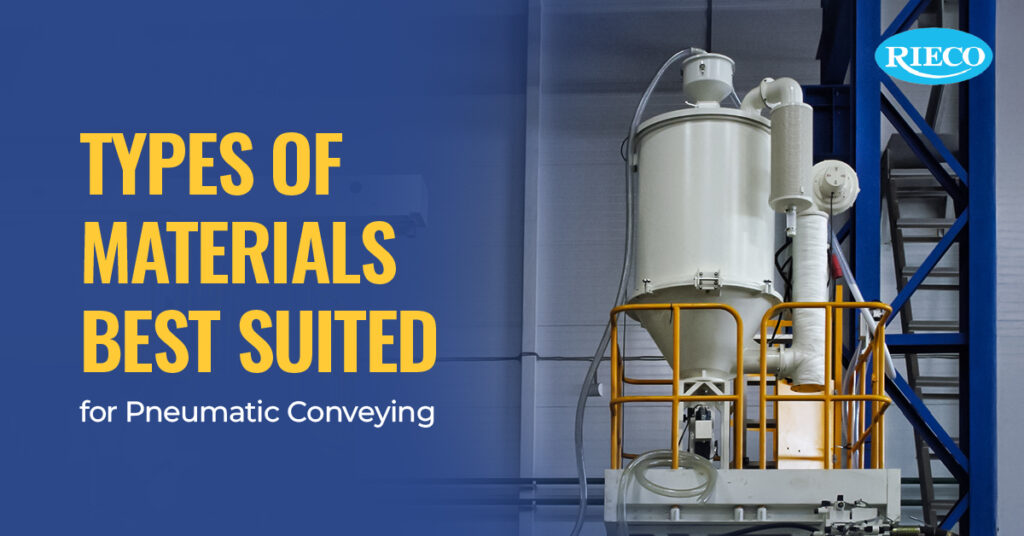
Pneumatic Conveying System
Pneumatic conveying is one of the most reliable ways to move powders and bulk solids across plants. But not every material behaves the same when it travels through a pipeline. A system that works perfectly for sugar may fail when used for cement or fragile food ingredients. The key to success lies in matching the right system to the right material. This blog explores the types of materials best suited for pneumatic conveying, why their properties matter, and how industries handle these challenges.
Understanding Pneumatic Conveying
At its core, pneumatic conveying uses air to move materials through pipes. Instead of relying on belts or screw conveyors, air carries the product from one point to another. The design may use either negative pressure (vacuum) or positive pressure (compressed air). This approach is especially useful in industries where hygiene, space, or dust control is critical.
The effectiveness of pneumatic conveying depends not only on the equipment but also on the nature of the material being conveyed. Particle size, density, and moisture content can make the difference between a smooth transfer and constant blockages.
Key Material Properties That Influence Conveying
Before looking at the types of pneumatic conveying systems, it is important to understand what makes each material unique.
- Particle size and distribution: Fine powders like flour behave differently from coarse granules like plastic pellets.
- Bulk density and flowability: Heavier or cohesive materials need more energy to move.
- Moisture content: Sticky or damp powders can clump and clog pipelines.
- Abrasiveness: Materials like fly ash or sand wear out bends and valves faster.
- Fragility: Delicate food ingredients can break apart if handled too aggressively.
Knowing these properties helps engineers choose the right method of transfer.
Types of Materials Best Suited for Pneumatic Conveying
Free-flowing powders
Powders that move easily, such as flour, cement, or sugar, are highly compatible with pneumatic systems. They can be conveyed over long distances at high speeds without significant risk of blockages. Dilute phase conveying is often chosen for such materials because it uses high-velocity air that keeps powders suspended and flowing smoothly.
Granules and pellets
Plastic pellets, pet food, or fertilisers fall into this category. They are stable in shape and size, making them easy to handle in both dilute and dense phase systems. For long distances or higher capacities, pressure-based systems are often preferred. When product quality is critical, dense phase is used to reduce friction and prevent damage to pellets.
Abrasive materials
Fly ash, metal powders, or minerals like sand are abrasive. These materials wear down pipes and fittings quickly if not handled correctly. Dense phase conveying is usually the safer choice, since it moves materials in slow-moving slugs rather than at high velocity. Protective linings in pipelines and wear-resistant bends are also used to extend system life.
Fragile or sensitive materials
Food ingredients such as cereals, nuts, or certain chemicals can degrade or break apart in high-speed systems. To protect product integrity, dense phase conveying with lower velocity is ideal. It reduces impact and maintains product quality during transport.
Hygroscopic or sticky powders
Powders that absorb moisture, like milk powder or starch, pose challenges. They can form lumps and stick to pipelines. Systems for these materials may need air drying, temperature control, and special receiver designs to maintain consistent flow.
Choosing Between Dilute and Dense Phases
The choice between dilute and dense phase hinges on both material type and process needs.
| Material Type | Better Suited Conveying Phase | Reason |
|---|---|---|
| Free-flowing powders | Dilute phase | Easy suspension, fast transfer |
| Granules and pellets | Both | Flexible depending on distance and care needed |
| Abrasive powders | Dense phase | Slower velocity, less wear |
| Fragile materials | Dense phase | Gentle handling |
| Hygroscopic powders | Dense phase (with controls) | Prevents clumping and blockages |
This quick comparison shows why understanding materials is central to selecting the right method.
Practical Challenges and How to Overcome Them
Even when materials are well-suited to pneumatic conveying, challenges remain.
- Segregation: In blended powders, fine particles may separate during transport. Solutions include dense phase conveying and proper line routing.
- System blockages: Sticky powders cause clogs. Pre-drying or controlled humidity can help.
- Dust hazards: Fine powders may pose explosion risks. Dust collectors, filters, and explosion isolation equipment are critical.
- Wear and tear: Abrasive materials damage pipelines. Using ceramic-lined bends and slower conveying speeds reduces maintenance needs.
Industry Examples
- Cement: Bulk powders like clinker, fly ash, and gypsum are moved over long distances. Dense phase systems are common here.
- Food: Ingredients like flour, sugar, and cereals require hygienic handling. Vacuum conveying prevents contamination and maintains product quality.
- Plastics: Pellets and granules are conveyed across large plants for moulding and extrusion. Systems are designed to reduce dust and protect pellet integrity.
Each sector benefits from pneumatic conveying, but the success lies in understanding the unique properties of its materials.
Conclusion
Pneumatic conveying offers a versatile way to move powders and solids, but the choice of system depends entirely on the material being handled. Free-flowing powders, granules, abrasive minerals, fragile food items, and hygroscopic powders each require specific approaches for smooth and safe transfer. Matching material properties with the right design reduces downtime, protects product quality, and lowers maintenance costs.
At RIECO, decades of experience in handling a wide range of materials have shaped how systems are engineered. With advanced powder testing and a focus on safety, hygiene, and efficiency, RIECO provides solutions tailored to the demands of different industries.


